Turning decades of freight data into a living simulation of the global supply chain
project44 has historically excelled at providing shipment visibility, tracking freight in motion and serving dynamic ETAs along the way. But a single number like an ETA does not tell the whole story. It couldn’t tell you why a shipment was late, what would have happened if you’d chosen a different carrier, or what to do right now about the storm bearing down on a port your cargo hasn’t reached yet. That gap is what led us to pursue something fundamentally different: a World Model.
Language models learn the patterns behind text. World models learns the patterns behind space and time. That means learning how light falls on a surface, how a garden might look from an angle no camera has ever captured, and how objects move and respond to force based on the laws of physics. A supply chain world model learns that same kind of pattern but applied to global trade. It learns how a network reacts to disruption. It learns how a vessel adjusts course in bad weather. It learns how congestion builds at a port before it ever shows up in a status update. And it learns how a geopolitical event can ripple forward into a shipment’s ETA, days before that event even happens.
What is a world model?
A World Model is an AI system that doesn’t just predict a single outcome. It learns how the entire freight network behaves, then simulates thousands of possible futures for any shipment in motion. Instead of just saying ‘arriving Tuesday,’ it predicts the probability of delay from disruptions like port congestion or bad weather and recommends the best route to meet customer priorities.
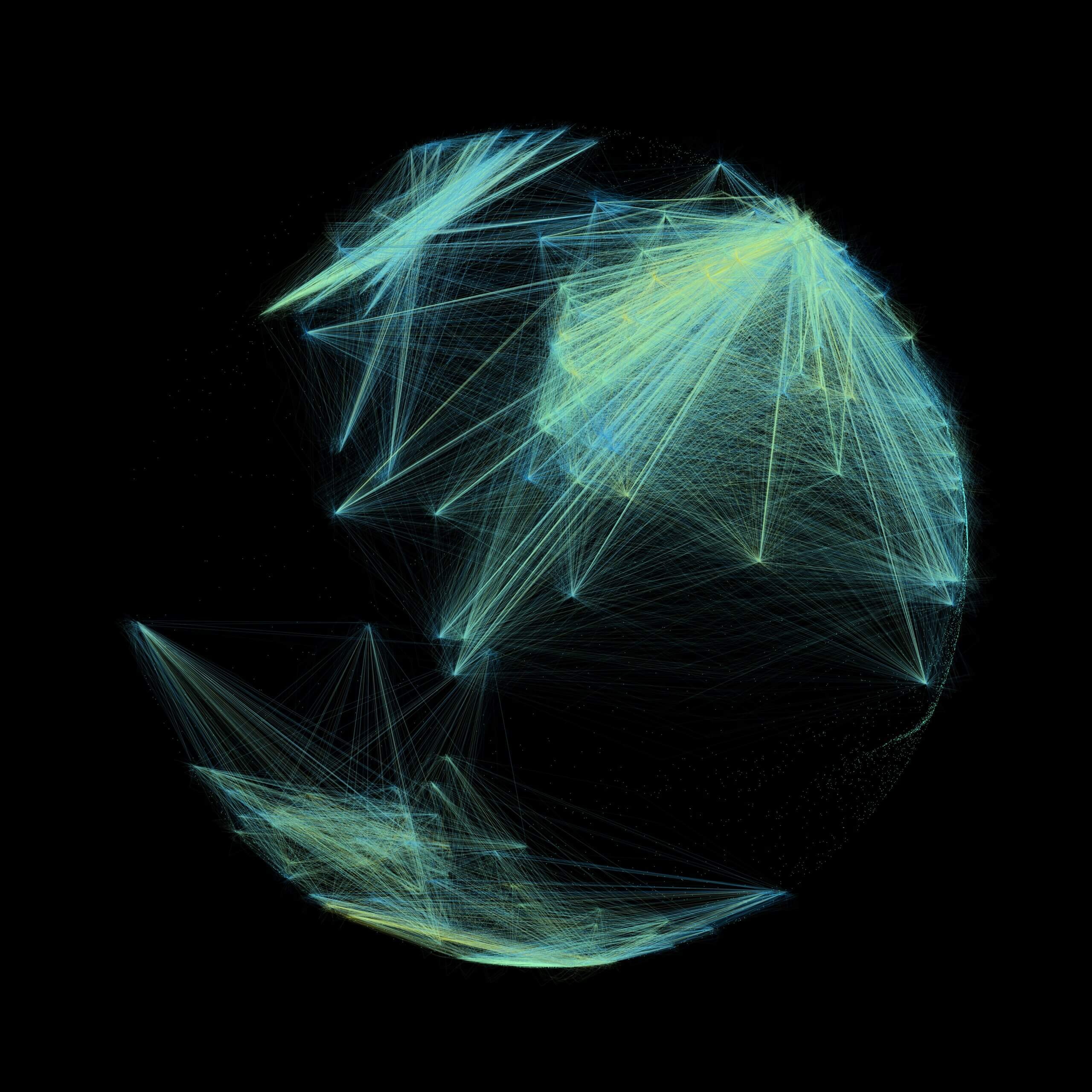
NVIDIA is building world models to help machines understand physical environments. Microsoft’s Aurora does something similar for weather systems. What sets project44’s version apart is the network it runs on. It’s built on visibility across hundreds of thousands of carriers, millions of active lanes, every mode of transport, and billions of shipment events a year. No single carrier or shipper can see the network this way, and that’s what makes the simulation possible.
Architecture
The World Model is a five layered stack where each one builds on the reliability of the one below it. The bottom two layers are extensions of things project44 already does well. Nothing in Layer 3 runs until Layer 2 is trustworthy, and nothing in Layer 5 ever recommends a real-world action until it’s been proven safe in Layer 4’s explanations first. That ordering is deliberate . It’s what makes the recommendations something a customer can act on with confidence, not a black box.
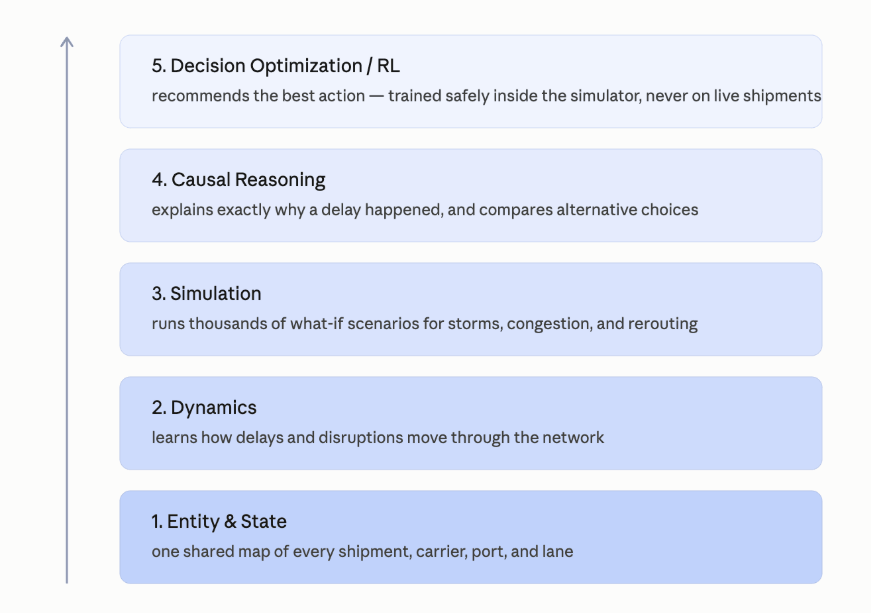
1. Entity & State
Every shipment, carrier, port, facility, and lane gets placed on one connected map, indexed on the same H3 geospatial grid project44 already uses. Before this layer, our FTL, Ocean, and theft-detection models each kept their own separate view of the network.
2. Dynamics of the network
This is where FTL ETA, Ocean D2D, and the port congestion model stop working in isolation. A connected, graph-based model learns how a delay at one point like a congested port, a late carrier etc flows through to affect everything downstream, the same way a real network does.
3. Simulation layer
Instead of giving you one single ETA, this layer runs hundreds of realistic what-if scenarios for a shipment. It can simulate different weather paths, congestion levels, and routing choices, then give you a range of outcomes with real probabilities attached.
4. Causal Reasoning
This layer figures out what’s actually causing the delay. It breaks down how much came from the storm, the port, or the carrier. That way, a team can act on the real cause instead of guessing.
5. Decision Optimization via Reinforcement Learning
This layer decides what the network should do. It learns the best carrier, route, or transfer point to balance cost, service, and risk. It’s trained and tested entirely inside the simulator, following real contract and business rules. It only gets used on a real shipment after it’s proven itself in simulation first.
Underlying Data Layer
A world model is only as good as the data it is built on. We need to provide details on how shipments are created and how they progress through the network. Years of GPS pings and lane history teach the model how trucks and vessels really travel. Dwell data of trucks and vessels shows the temporal and spatial patterns of stops and how they impact estimated arrival times. Theft hotspots teach the model the locations to avoid, to prioritize safety. Historical storms, port strikes and geopolitical events teach how the world’s chaos actually pans out, lane by lane. Cost data including detention charges, expedite pricing turns predictions into decisions, letting it weigh a reroute against a penalty. Human verified root cause labels enable the model to reason through potential scenarios that caused delays in shipments. All this together is what gives it judgment and the ability to reason about what’s coming, not just report what already happened.

Potential applications
The same engine that plans and rescues one shipment can answer a whole family of questions. The underlying methodology is to simulate what could happen, weigh the tradeoffs, and recommend the option that holds up in the real world. For ocean route planner use case the world model stops picking the sailing with the shortest scheduled transit time and instead simulates weather, port congestion, schedule reliability, and geopolitics to recommend the option most likely to arrive on time. As a transshipment rebooking advisor, it tracks a delayed connection in real time and tells operations whether to wait, rebook, or reroute before a missed connection turns into a large demurrage cost. As a route and risk optimizer for high value cargo, it weighs traffic, weather, and theft hotspots against speed, then chooses the path that best protects the shipment. This is proof that the model isn’t a single-purpose tool. It’s a general way of reasoning about risk, and it can be applied to whatever decision comes next.
A world model like this would help solve hard problems that generate real impact. There will be fewer early and late arrivals against fixed lead times, real dollars saved by avoiding missed connections and demurrage, and fewer incidents on flagged routes. Customers will be increasingly acting on what the model recommends instead of working around it.
Every logistics company has ETA models. Very few have the data to build a true World Model, and none have project44’s view of the network. That combination of the massive scale of P44 data coupled with the ability to simulate is a key enabler that makes building world model possible. It turns visibility into the ability to see a disruption before it happens and acts while a favorable option is still on the table.
That’s the answer to every customer who’s ever asked us for more than a tracking number. It’s also the clearest reason why this is worth continued investment. We are not adding a model to the portfolio, instead we’re building the layer every future model including ETA, risk, fraud, LTO, planning will eventually run on top of.