Previous reports in this series
- Weeks 1 to 2: First diversions recorded. UAE, India, Sri Lanka absorb initial rerouted volumes. Jebel Ali import dwell begins climbing.
- Weeks 3 to 4: Cargo reaching Singapore, Colombo, Mundra. Carrier schedule changes formalise. Jeddah absorbs Gulf-side Saudi traffic.
- Week 5: India under pressure. Mundra arrival delays reach 47+ days. Hambantota absorbs a two-wave surge.
- Week 6: Saudi Arabia volumes up ~85%. Pakistan collapses 93% as carriers avoid the northern Arabian Sea. Jeddah confirmed as relay hub.
- Week 7: UAE loop tightens: Jebel Ali to Fujairah to Khawr Fakkan. 496 shipments on that lane vs. zero in Weeks 1 to 4. Import dwell 46.9 days.
Full weekly series: project44.com/hormuz-intelligence
The Cape surge: By the numbers
Within days of Strait of Hormuz disruption, the Cape of Good Hope began registering elevated volumes. Eight weeks later, that signal has become one of the clearest indicators of how far the structural rerouting has progressed.
TOTAL TEU GROWTH
~2.5x
85k/wk (Jan) to 252K peak (Apr 6)
PEAK WEEK UPLIFT
+71%
Week of Apr 6 vs pre-conflict avg
DURBAN PEAK
110,770
TEU arrivals Mar 30 (>2σ outlier)
5-PORT AVG UPLIFT
+21%
Post-conflict vs pre-conflict baseline
Total weekly TEU arrivals across the five Cape-route ports grew from roughly 147,873 TEU per week in early January to a peak of 252,792 TEU on 6 April, a ~2.5x increase in under four months. The five-port combined average is up 21% post-conflict. The week of 6 April is the single highest week in the dataset, surpassing 220,032 TEU on 30 March and exceeding the December 2025 pre-holiday surge.
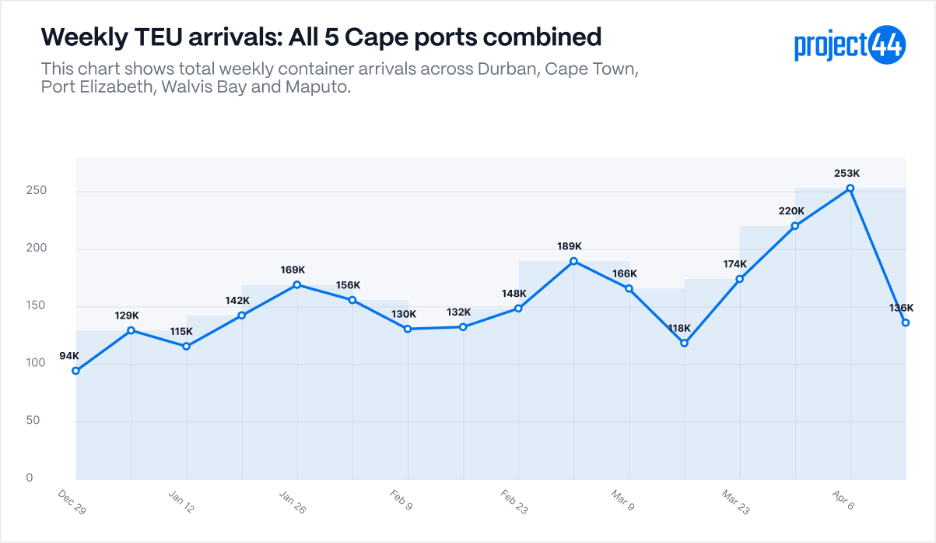
The post-conflict surge is categorically different in magnitude: every post-conflict week from 2 March onward exceeds the pre-conflict average, with two weeks (30 March, 6 April) setting all-time records.
Port-by-port breakdown
The geographic pattern of which ports are surging is precisely what rerouted Asia to Europe cargo would produce.
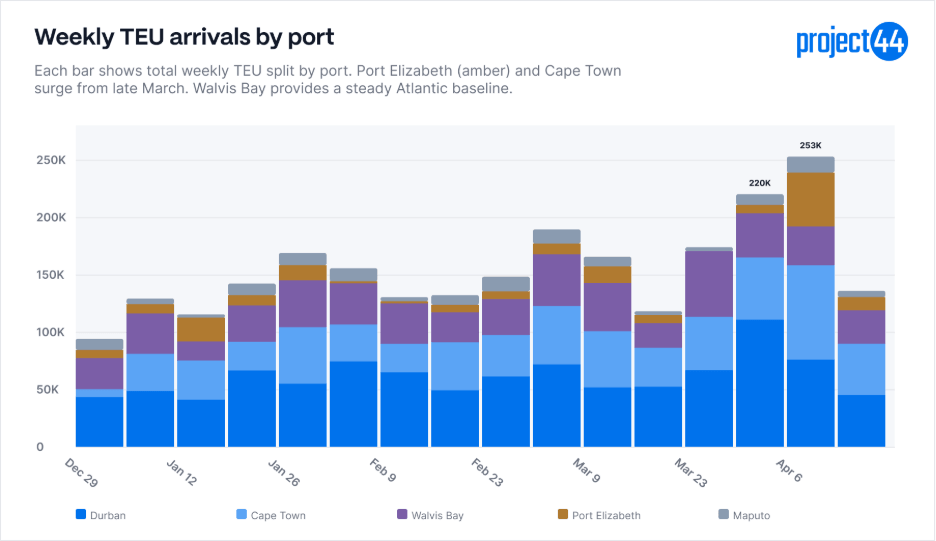

Durban accounts for roughly 45% of five-port throughput. Its peak of 110,770 TEU on 30 March is more than two standard deviations above its pre-conflict baseline. Cape Town peaked at 82,212 TEU (+138%) on 6 April. Port Elizabeth is the standout: 46,865 TEU on 6 April represents +446% above its pre-conflict average of 8,475 TEU.
What comes next
Three questions will determine how the Cape signal evolves:
- Durban capacity ceiling. At 110,770 TEU, 30 March is already a more than two standard deviation outlier, and 6 April added further pressure at 252,792 TEU combined. If congestion follows, Cape port dwell times will replicate what the weekly series documented at Mundra and Jebel Ali.
- Walvis Bay transshipment function. Its 33K TEU/week baseline and 57K peak suggest carriers are using it as an active relay hub. If Durban congests, Walvis Bay becomes the logical pressure-relief valve.
- Permanence of structural routing changes. Carriers do not reverse structural schedule changes overnight. Every additional week of Hormuz closure embeds Cape routing more deeply. The re-diversion era average of 152,949 TEU/week is the highest in the historical dataset.
The Hormuz closure is not a regional event. It is a structural rerouting of global container flows, and the ports of southern Africa are now the most precise real-time barometer we have of how far that rerouting has gone, and how much further it may still travel.