Overview
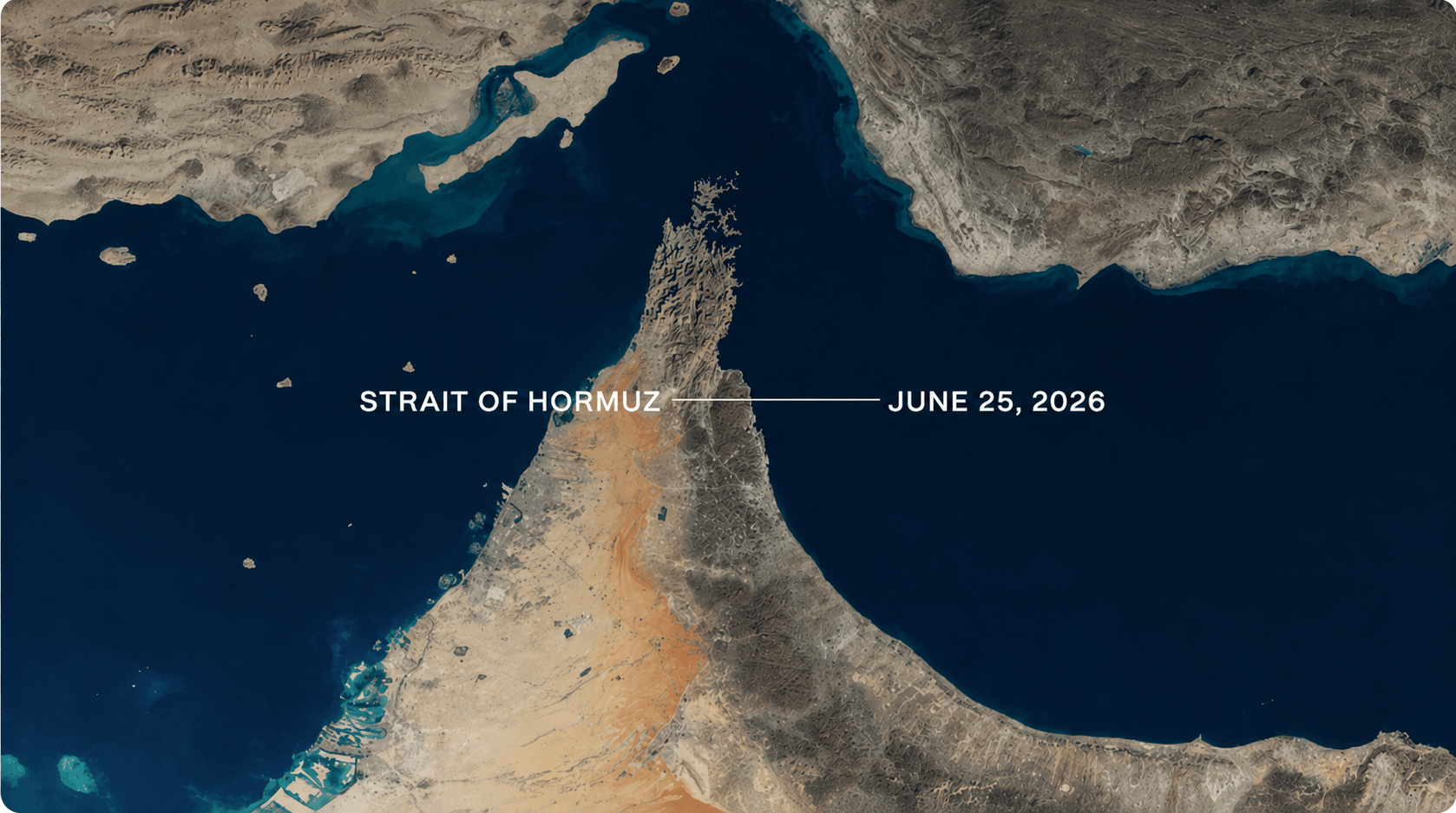
Over the past twenty weeks, the Strait of Hormuz has experienced extreme disruption due to an ongoing conflict between the US and Iran. After opening one month ago, further escalation resulted in the Strait closing again. Vessel traffic through the Strait remains less than 20% of pre-conflict levels, with hundreds of vessels waiting in the region. Recently, the Houthis announced a naval blockade on Saudi Arabia, expanding the conflict to the Red Sea and further spiking global oil prices.
This report details the downstream supply chain impact of these events, including how diversions rose, which routes absorbed them, and how that pressure affected port congestion and cargo volumes across the region.
Diversions plateau rather than decline amid Hormuz chaos
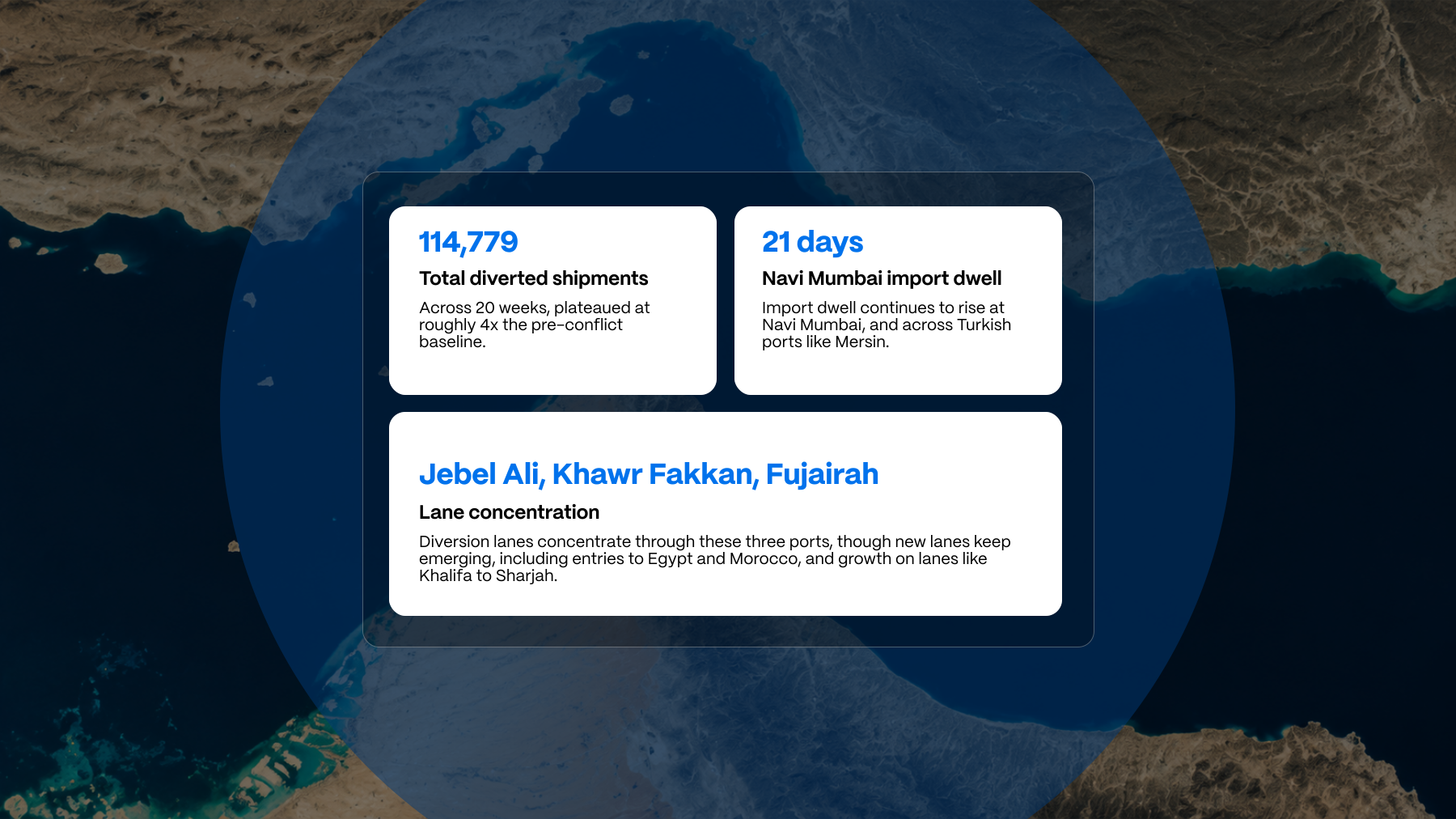
The supply chain impact of global disruptions follows a typical pattern. Diversions and impacted vessels and shipments spike significant when the event occurs, carriers and networks adjust, and the impact declines steadily over time. The situation in the Strait of Hormuz is unique, rather than dropping, diversions are plateauing at 4x pre-conflict levels. Since week 9, every week has fallen inside a 3,718 to 5,404 shipment band, compared to the pre-conflict baseline of 1,118 shipments per week. The steady volume and recent increase of diversions around the Persian Gulf reflect the extreme uncertainty and significance of Hormuz as supply chain choke point that lacks effective alternative routes.
Weekly Diversions
project44 supply chain insightsWeekly diversion volume with key geopolitical events marked above the bars. Hover a marker for the event, hover a bar for the count.
A diversion refers to a shipment that has had its scheduled port of call changed while in transit. While diversions are a leading indicator of the significance of a disruption this number does not include newly restructured trade lanes that are avoid the Persian Gulf entirely due to the sustained conflict.
UAE remains top country for diversion volume, Saudi Arabia narrows gap
UAE diversion volume is highest in most weeks, though the difference versus Saudi Arabia has narrowed sharply from its week 4 peak but remains volatile rather than closed. The UAE recorded a higher weekly total than Saudi Arabia in 18 of 20 weeks, while Saudi Arabia’s total was higher in weeks 17 and 19. Qatar showed the steepest proportional decline of the four countries, from 316 in week 1 to 46 in week 20, an 85 percent drop.
Diversions by origin country
project44 supply chain insightsWeekly diverted shipments by Middle East origin country. The UAE drove the largest share throughout, though its weekly volume has cooled by roughly two thirds since the week 4 peak.
Intra-gulf lanes remain most affected
Reassigned shipments are concentrating on a small number of short intra-Gulf lanes rather than extending outside of the Middle East. The single busiest lane, Dubai (Jebel Ali) to Khawr Fakkan (9,370 cumulative shipments), carries more volume on its own than the four lowest-ranked lanes in the top 10 combined (8,163). Six of the top 10 lanes touch Khawr Fakkan on one end, together accounting for 61 percent of top-10 cumulative volume.
Two new destinations entered the top diversions in week 20: Jeddah to Port Said East, Egypt (not present until week 19, ranked 8th in week 20) and Jeddah to Tangier (Tanger-Med), Morocco (ranked 13th in week 20, up from rank 124 in week 19). Intra-Middle East lane volume remains prominent week over week.
Top diversion lanes
project44 supply chain insightsThe 10 busiest reassigned port pairs by cumulative shipments, week 1 through week 20. Short intra Gulf hops between UAE ports dominate the list.
Navi Mumbai import dwell continues to rise
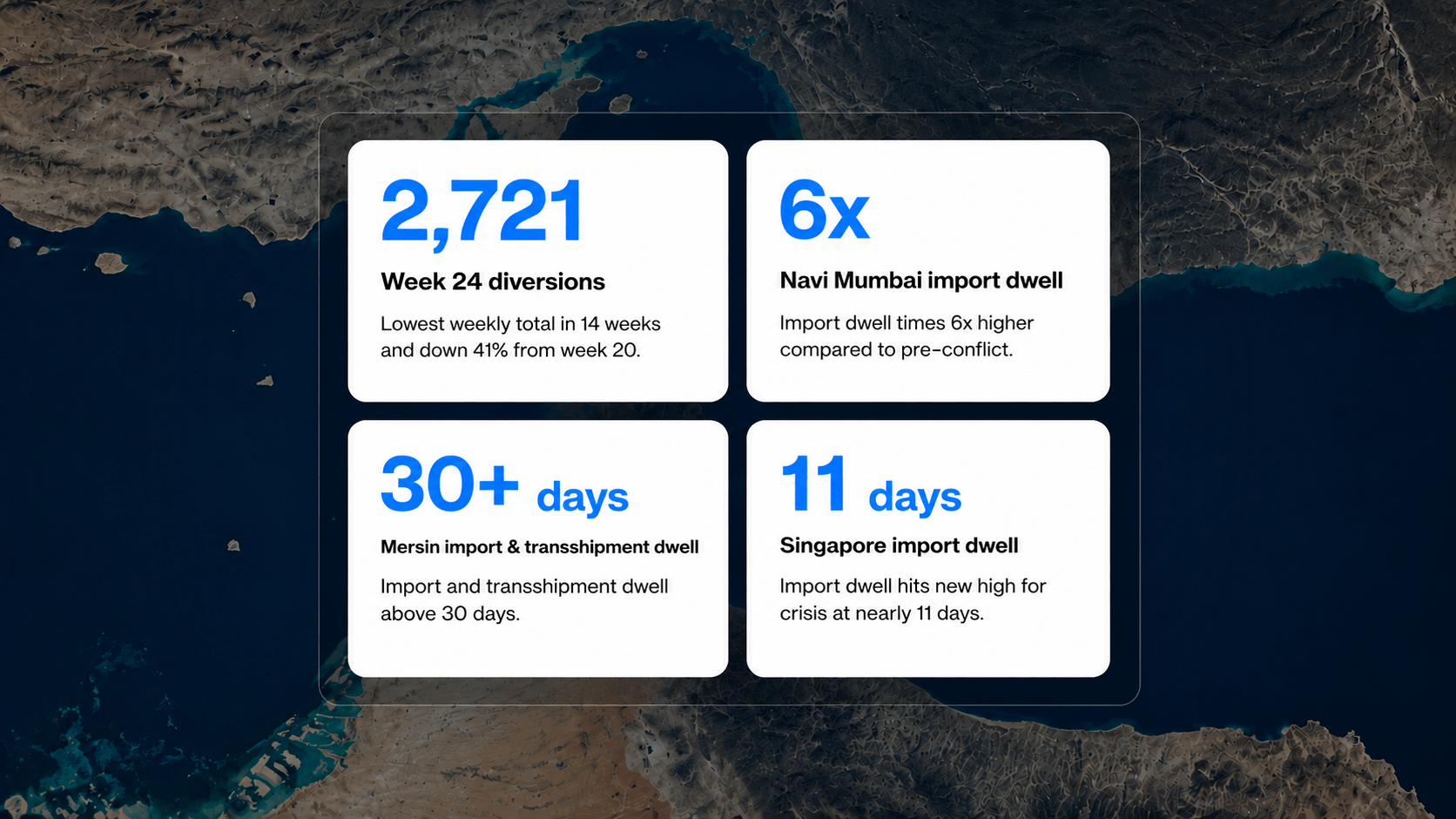
Unlike diversion counts, which are plateauing, port dwell is moving in different directions at different ports. As one of India’s largest and most important ports Navi Mumbi has acted as primary indicator of the downstream impact of the Hormuz crisis. Import dwell at Navi Mumbai has risen to 21 days, more than 4x its pre-conflict baseline as India absorbs cargo traditionally bound for the Middle East. Mersin, Turkey’s largest container port, has seen dwell increase by ten days since the reopening four weeks ago and now sits at 27.12 days of average dwell.
In terms of export dwell, since dropping to under 20 days when the Strait was reopened, Abi Dhabi has more than doubled over the past several weeks and currently sits at 48.5 days.
Port dwell at key ports
project44 supply chain insightsWeekly dwell in days across 15 monitored ports, week 1 through week 20. Pick a dwell type and a port, then hover the line for exact values.
The impact
The Gulf and Strait of Hormuz are known for moving a large share of the world’s crude oil, along with key petrochemical feedstocks like ethylene and propylene that feed global plastics manufacturing, roughly a third of global seaborne methanol trade (a core input for resins and coatings), and a notable share of the world’s fertilizer inputs, including about 49% of global urea exports, 30% of ammonia, and 25% of sulfur.
Disruption in the region doesn’t only delay oil; it forces longer diversion routes that raise fuel costs across the entire supply chain. In addition, petrochemical shortages ripple into plastics-dependent manufacturing from automotive to electronics to packaging. Fertilizer disruptions carry outsized consequences given planting-season timing and the lack of strategic reserves, with effects reaching far beyond the Middle East into major agricultural exporters like Brazil and India.